Architecture
ISA and x86 Instructions
- ISA(instruction set architecture) => machine code compile
#可以通过在C中嵌入汇编代码规定编译结果
- CISC(Complex Instruction Set Computer) and RISC(Reduced Instruction Set Computer)
Assembly Operations
- Arithmetic and Logic operations
- Transferring data between memory and register
- Control Logic
- Others
CPU Composition
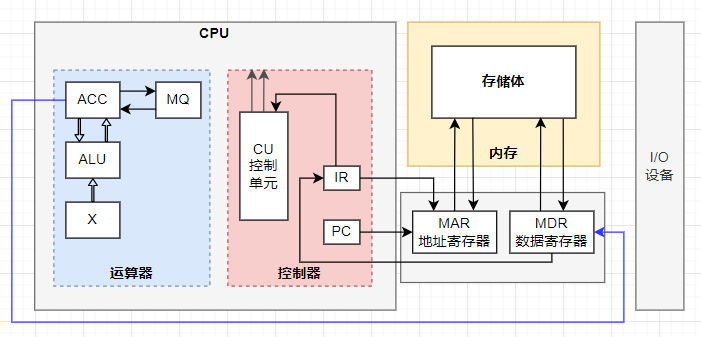
- PC (program counter)
- Register file (heavily used program data)
- Condition code
Register
-
Integer registers: 16 general purpose registers, 64 bits each
-
SIMD (Single Instruction Multiple Data) registers
-
Operations parallelize the execution in data-level
-
Compute for basic arithmetic and logic
-
Problem & Solution
-
Problem: Control divergence (来自if语句等)
-
Solution: only to accelerate calculating conditions / speculative execution
-
Processor Architecture
Microarchitecture: get designed for one ISA by different companies with different goals
CPU core work flow
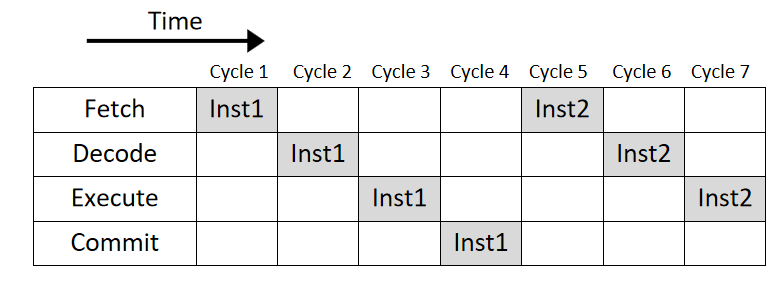
- Fetch - Decode - Execute - Commit (important for "out of order execution")
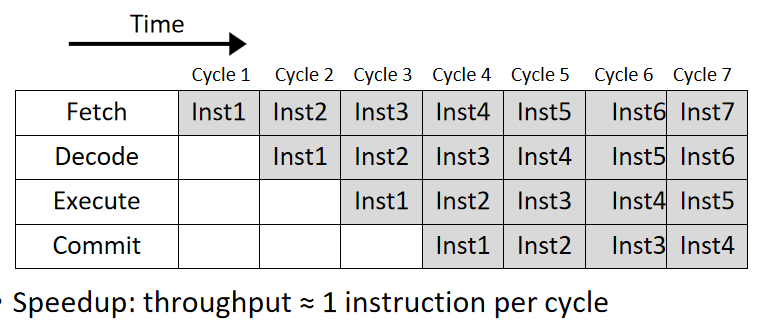
#These can be expanded (e.g. pre-decode, allocation)
- Pipeline: maximize the use of every cycle.
- Pipeline defect
- Data hazards (需要前一条的指令的结果)
- Control hazards (控制语句跳过后续指令)
-
Structural hazards (取存指令的冲突)
-
Optimization for control hazards
- Branch prediction (vulnerable to side-channel attacks)
- speculative execution
Memory Hierarchy
RAM
- SRAM (Static RAM): fast, costly ( e.g. : cache)
- DRAM (Dynamic RAM): slow, cheap, needs refresh
Memory Layout
- 堆(Heap)和栈(Stack)是计算机内存管理中两种不同的区域
- 栈(Stack)
- 分配:栈内存是由编译器自动分配和释放的。它遵循后进先出。大小较小,速度较快。
- 管理:线性分配的,通过栈指针来管理。栈内存的生命周期严格受限于作用域,函数返回时栈帧被销毁。
- 堆(Heap)
- 分配:堆内存是由程序员手动分配和释放的。需要OS等程序管理内存块,处理碎片。堆通常较大,可以动态增长,按需分配。
- 管理:非线性分配的,通过函数管理(如malloc, free)。生命周期由程序员控制。
Virtual Memory
- OS utilizes virtual memory to isolate address spaces of different processes and provide linear address space.
- Address spaces are comparted into pages (typical size = 4KB)
- Upon access to a virtual address, hardware + OS (with a page table) converts it to a physical address
- If target page not in main memory, a page fault is triggered and OS has to load that page from disk (very slow)
Locality Strategy
- Temporal locality
- Spatial locality
Non-uniform Memory Access(NUMA)
- Independent local memory, commute by interconnect.
- Pros: avoid cache incoherence, exclusive memory space
- Cons: high time cost between different memory, watch out!
cache
- SRAM-based staging area for a subset in larger devices.
- Hierarchy: L1(~10kb), L2(~100kb), L3(~10mb, often shared)
-
Usage: read hit / read miss / write hit / write miss
-
Organization
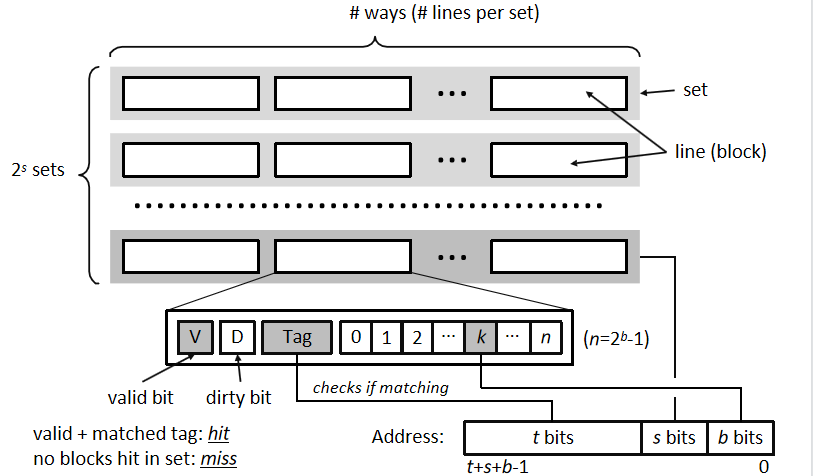
Unit parts: valid bit, dirty bit (if written) ,tag(check)
-
Cache coherence:
-
Problem: Private caches of different cores may contain the same cacheline.
-
Solution1:MSI Protocol, when write, broadcast a message on the interconnect to invalidate this cacheline in other caches.
Concurrency Basics
Processes vs. Threads
- Similarity: own logical control flow, run independently, context switched
- Difference:
- 概念:进程是操作系统资源分配的基本单位,线程是 CPU 调度的基本单位,线程可以被视为进程的子集。
- 资源:同一进程中的线程共享资源,但每个线程具有独立的栈和寄存器;进程之间一般相对独立。
- 开销:取决于地址空间和资源的共享与否,线程的创建销毁相对进程开销都较小。进程的通信开销也更大。
Critical Section
- Definition: a block of code that only one thread of execution can enter at a time.
- Aim: Avoid conflict of a shared resource by multiple threads
- Solution: thread synchronization (E.g. readers-writer lock)